

SEO or Google Ads? A decision guide for Delhi NCR businesses
If you run a business in Delhi NCR and you have one budget to spend, the question of SEO or Google Ads is not really about which channel is better. It is about which one you fund first, and for how long.
We get asked this most weeks. A dentist in Greater Kailash wants to know why the clinic two lanes over sits above her. A furniture workshop in Kirti Nagar wants to stop paying for every click. A D2C brand in Gurgaon wants both channels running by Monday. The advice we give is the same in all three cases, and it starts with a line most agencies avoid saying out loud.
For a lot of Delhi NCR businesses, Google Ads should come first and SEO should come second. Not because ads are better. Because ads tell you what to build.
That is the whole argument in one sentence, and the rest of this guide is the reasoning, the rupees, and the exceptions where we tell a client to do the opposite.
What each one actually buys you
The two channels get compared as if they were the same product at different prices. They are not. One rents attention. The other buys an asset.
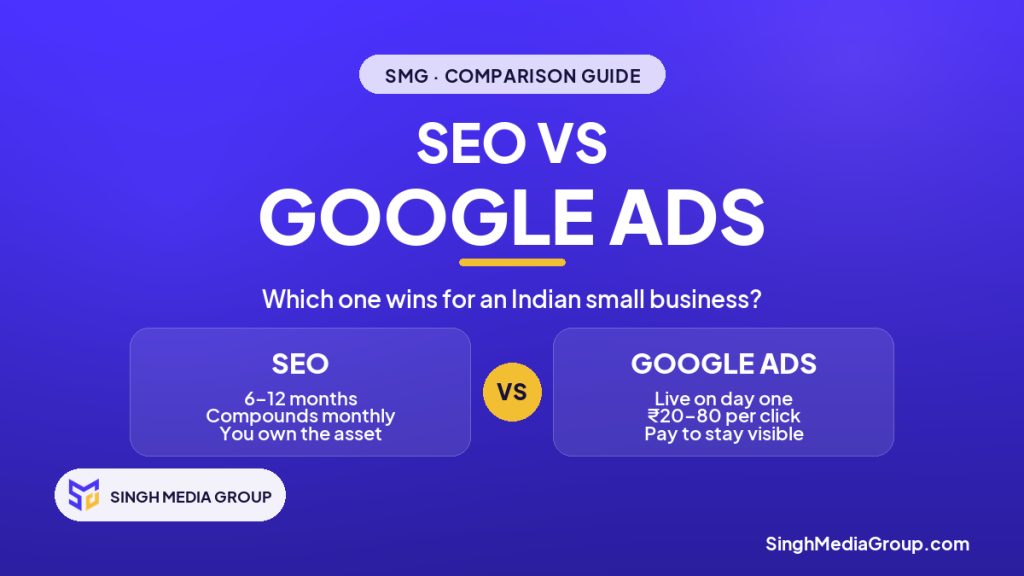
| | SEO | Google Ads |
|—|—|—|
| Time to results | 6-12 months | Day-one results |
| Typical monthly cost | Rs 25-60K per month | Rs 20-80 per click |
| What you end up with | You own it | Stops when you stop |
Google Ads is rented attention with a meter on it. You bid, you appear, you pay per click. In Delhi NCR auctions the click price moves around a lot: a local service keyword in a crowded locality can sit at the low end of that Rs 20-80 band while a competitive commercial term in a metro-adjacent market pushes toward the top. You get day-one results because you are buying position rather than earning it. The traffic starts the day the campaign goes live, and it stops the day the money does.
SEO is slower and structurally different. You spend Rs 25-60K per month for six to twelve months before the work carries real weight, because you are improving a profile, a site and a set of pages that Google has to re-evaluate. What you build, you keep. The rankings, the content, the Google Business Profile, the citations. Nobody can switch it off, and you are not bidding against your competitor every morning to stay visible.
Then there is the line on the cover that decides more than people expect. Ads stop when you stop. SEO does not stop the moment you stop, but it does decay, and this is where most owners get surprised in both directions. If you cancel an Ads account you lose the leads that week. If you stop SEO, the calls taper. They do not vanish on day three. What you paid for keeps paying you for a while, then slowly stops, faster than you would like if competitors are publishing while you are not.
So the honest framing is not that ads are temporary and SEO is forever. It is this: ads switch off instantly, SEO switches off slowly, and neither one is a tap you can leave running for free.
The cost maths nobody writes down
Most of the SEO vs Google Ads argument online stops at a monthly figure. That figure is the least useful number in the discussion, because Rs 40,000 per month means entirely different things in each channel.
Start with Ads. Take Rs 40 per click, which sits in the middle of our Rs 20-80 planning range and is a fair planning number for a lot of local Delhi NCR terms. At that price, a monthly spend of Rs 30,000 buys roughly 750 clicks. If three in a hundred of those clicks turn into an enquiry, you are looking at about 22 enquiries a month, or roughly Rs 1,350 per enquiry.
Now run the top of the range. At Rs 80 per click, the same Rs 30,000 buys about 375 clicks. Same conversion assumption, and you are at 11 enquiries, or around Rs 2,700 each.
Two things about that arithmetic. It is arithmetic on a stated assumption, not a benchmark, and your conversion rate is the number that decides everything. Three in a hundred is a placeholder to show how sensitive the outcome is. Move it to one in a hundred and the Rs 40 case jumps from Rs 1,350 per enquiry to Rs 4,000. That sensitivity is the point. In Ads, your click price is set by an auction you do not control, so your margin lives or dies on how well your page and your offer convert.
SEO works the other way. You do not pay per visitor, so the cost curve improves with time instead of staying flat. But the entry cost is real and it is front-loaded. Six months at Rs 40,000 is Rs 2.4 lakh spent with no guarantee, before the work is carrying much weight. A full twelve-month run at the same figure is Rs 4.8 lakh. Owners who want the honest version of this comparison should look at that number and ask whether they can fund it without needing the phone to ring from it.
After that point, the comparison flips. Once a page ranks, the next visitor costs you nothing extra, so the cost per enquiry keeps falling as long as the ranking holds. Ads never do that. The 750th click costs the same as the first, this month and next year.
Which is why the cheap answer to the SEO or Google Ads question is usually wrong. Fees compare. Outcomes rarely do.
The order we actually recommend
Here is the part most agencies will not write down, because it means telling a client to spend money with them in a sequence rather than all at once. It is also the part of the SEO or Google Ads debate that changes your results, because the order you fund them in matters more than the split.
Run Ads first, narrowly, and use them as research. Not to carry the business. To find out which keywords bring buyers rather than browsers, which locations produce calls, which offer makes someone pick up the phone, and which of your pages converts at all. You get that answer in weeks instead of quarters, and you get it with real money and real buyers.
Then point SEO at what the Ads data proved.
This sounds obvious and almost nobody does it. The usual sequence is the reverse: sign a six to twelve month SEO retainer, spend the first quarter optimising for keywords chosen in a meeting, and find out in month seven that the pages were aimed at terms that never converted. Ads show you the answer first, for a few thousand rupees of test spend, and then your SEO budget goes to work on things you already know people buy.
A practical sequence for a Delhi NCR business with roughly Rs 40,000 to Rs 60,000 a month to put into growth:
Months one to two, put it all into Ads on a tight set of high-intent keywords. High intent means the person is looking to buy, book or hire, not read. Ten to fifteen keywords is enough to learn from. Keep the geography to the pin codes you can actually serve.
Months two to four, while Ads are running, build the pages that the click data says matter. Service pages for the terms people actually searched, a profile that matches, and a contact path that takes two taps.
Months four to twelve, move the emphasis to SEO with Ads still covering the head terms you cannot win organically yet. This is where the two stop competing for the same budget and start covering different parts of the funnel.
One warning about splitting. If you have Rs 30,000 a month, we would rather see it go properly into one channel than thin into Rs 15,000 each. A Rs 15,000 monthly Ads budget in a competitive Delhi NCR category often cannot buy enough clicks to learn anything, and a Rs 15,000 SEO retainer usually buys maintenance rather than movement. Half of two things is usually worse than all of one.
How to tell which you need first
Work down this list and stop at the first line that describes you.
If you need enquiries this month and can fund three months of spend without panic, run Ads. Speed is the entire reason to pay per click.
If your margins are thin and the clicks you need cost more than about Rs 50 each, start with SEO. Paying premium click prices on a low-margin product is how small businesses burn a year of profit in one quarter.
If you have a physical shop and you have never claimed your Google Business Profile, do neither yet. Claim it, fix the category, add real photos and answer the phone. That work costs nothing and it often produces more calls than the first Rs 20,000 of Ads would.
If your site does not show a phone number or a working enquiry form within a few seconds of loading, fix that first. Both channels pour traffic into whatever you have. Neither fixes a page nobody can act on.
If you plan to sell the business in the next two years, weight toward Ads. An SEO asset takes time to build and its value is not always recognised in a sale.
If you want the calls to continue after you stop paying, weight toward SEO, and plan for the decay rather than pretending it does not happen.
If you can fund both, fund Ads now and SEO from month four, which is the sequence above.
Where we sit
We run both for Delhi NCR businesses, and we are not neutral about which comes first. Starting a client on a twelve month SEO retainer when their click data has never been tested is a good way to spend their money on our assumptions. Ads give us the evidence in weeks. Then we build something they own.
That is also why we ask for the awkward numbers at the start of a project. Monthly spend, current cost per enquiry if you know it, margin per sale, and how long you can go without the phone ringing. Without those, any recommendation about SEO or Google Ads is a guess dressed up as strategy.
If you already know your per-click cost and your conversion rate, you can run the arithmetic above on your own numbers tonight. If you do not know them, that is usually the first thing worth fixing, before either channel gets a rupee.
Related Reading
Service: SEO Services
Read next: meta-ads-vs-google-ads-delhi-ncr